I got an anonymous link to a few photos found on WineTwo.net. Upon following it, I discovered the obvious images I assume I was meant to find for this weeks HOT WINE PIC.
Oh yeah, it’s hot! And so is she, whoever she might be.

I got an anonymous link to a few photos found on WineTwo.net. Upon following it, I discovered the obvious images I assume I was meant to find for this weeks HOT WINE PIC.
Oh yeah, it’s hot! And so is she, whoever she might be.

It wasn’t all that long ago that I was up in the Santa Maria area for the Santa Barbara Vintner’s Festival. It was a wonderful event held at the grounds of the Firestone Winery with something like 90 wineries represented, and 60 chefs! Sounds like a wino-foodies dream, doesn’t it? And while we did enjoy the day immensely, we quickly learned there was something putting limits on our desire to indulge…and that was a lack of diversity. While some of the wine was amazing….it was nearly ALL Pinot Noir! There was a Cab here and there, and a splattering of other sips I have since forgotten, but for the most part Pinot ruled the day.
I mention my sad experience from about four years ago because although I have been visiting the lovely Santa Barbara area (the wine region is fairly huge, and includes but is not limited to 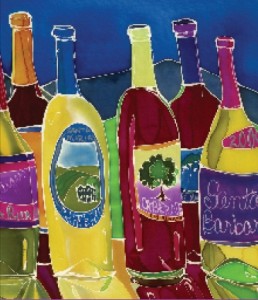 Santa Maria, Los Olivos, and Santa Ynez valley) for its wine country since the early nineties, this experience made me all the more appreciative of the relatively tiny wine valley I now call home. One of the greatest things about Temecula’s wine country is what people in the know call “microclimates”. (We are talking about those folks who know a lot more about vines and soil and climate, and the sum of all the parts called “terroir” than little ol’ me. I am just passing on what I’ve gathered over the years from listening to them). I guess what that means is that we have out here in our valley many different diverse ecological sects, which apparently vary enough to support grapes that benefit from those differences. I am not saying that every type of varietal grows well here, but I will say that it seems this somewhat complex landscape does allow for some good stuff from many wine regions.
The big boys…the most well known and historically identifiable grapes, the most common of the Bordeaux berries, are the ones I honestly have the hardest time with out here. I am sure that some of the locals will hate me for saying that, but this is my personal truth. If you have a better story, bring it. So, anyway, good Cabernets, while possible, are what I have found the least of in Temecula. That goes for Merlots as well. That doesn’t mean you won’t find an outstanding Cabernet at the right winery if you are there at the right time. I have heard more than one senior winery associate say that Cabs are pretty hearty and do just fine in our arid little valley. I can only speak from what has hit my own palate, however, and the little bit of wisdom I have gleamed from quite a few years working in different wine houses. The Bordeaux region is damper and colder on average than So Cal….and that’s just how it is….
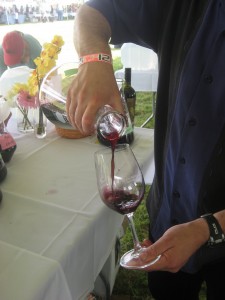 That said, some of the other lesser known or lesser produced wines from that region, such as Cabernet Franc, and Petit Verdot are quite often robust, interesting and all around impressive. I’m not sure why these varietals from the Bordeaux region handle heat and gravely, loam soil better than their more popular counterparts, but I will say when you get to Temecula and you see one on a tasting list don’t pass it up.
Then there are the varietals from many other regions that excite me and can be made into some of the best wines I have ever had the pleasure of consuming. No joke folks….the best….The Rhône’s love our soil, our climate, our everything. Syrahs are heavy, sometimes peppery, sometimes screaming out with vanilla but almost always jammy. I personally took one 2007 Temecula Syrah to a gathering with some Los Angeles wine snobs present ( I worked in the restaurant business in LA long enough to have residual friends who still work for high end joints that brag an impressive wine list). I didn’t tell anyone what I had in my brown bag, and waited until the first glass had been consumed for the most part. Then, casually, I moved about the room with bottle in hand, covertly covering the label with my palm. The nearly black elixir swirled and pooled in the bottom of glass after glass, and then, I waited. I didn’t have to wait long either, as the “m-mm’s”, and “oh, my’s” emanated from my guests. It was very satisfying to tell them it was a wine from Temecula…and not even a Reserve at that.
So, my “put that in your pipe and smoke it” Syrah was an example to my friends that we can make at least one kind of great wine.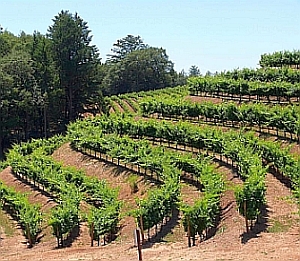 But there is so much more, and Grenache, Mourvedre (which actually hails originally from Spain), and Cinsault vines thrive and meet their true telos in good ol’ Temec. The Spanish ones love us as well….try finding a Tempranillo that isn’t brilliant in this town, unless she’s from out of town. The Mediterranean types…..well, those are amazing too.
I think that the best thing about this wine region, aside from its accessibility, might just be the huge selection of wines you will find here. Not that every winery knows what to do with them….which seems to be the biggest challenge. Maybe I need to tell you exactly where to go for what….so looks like there’s some research in my future!
Peace, love and vino!
Howdy Wino’s!
I may be finding a way back into Wine-dom and go figure, it may be an Australian wine at that! I’m interested in a Social Media and/or Event Marketing gig. Naw, we’re not talking big money but quite possibly big passion and in the long run, life is short baby! Enjoy it while you can.
Which leads me to ponder; Has anyone tried Razor’s Edge Wine before? I haven’t found it yet in my local market. I’d love some opinions on the product if anyone has one/some. Don’t be shy!
I made this clip simply out of inspiration.

The more I learn about wine, the less I know.
Structure.
Terroir.
Chewy.
Smoky.
Leather.
Mid-palate.
Malolactic fermentation.
Cult wine.
Food pairing.
Since my self-imposed wino education began three or four years ago in San Luis Obispo County, I feel as if I’ve immersed myself in a new world…and a new language. I carry on with my new-fangled wino terminology that continues to challenge me, forcing me to make use of handy vino books and magazines that sit quietly on my coffee table; and my resolve to stake my claim as a SLO County wine expert continues with no end in sight.
 After three or four years of wine immersion in SLO County—even after dozens of winery visits, countless tastings of local varietals, booking wineries into celebrity events for an international film festival, and loads of self-wino education, I am smart enough to realize that I still don’t know a hell of a lot. But maybe that’s okay. After all, isn’t edification a part of life, each sip a stepping stone?
Perhaps I take a step forward with every taste, as I bask in the fruits of the local terroir and continue to find local vines that  speak to me. My palate morphs; I find new favorites; I experiment; and I go with my wino instincts. Recently I hosted a small dinner party and frazzled a bit about finding the perfect wines to pair with a lovely appetizer course of sliced baguette that begged to be smothered in assorted cheeses (cow, sheep, and goat), tart olives, fresh farmer’s market veggies, and a zingy citrus dip loaded with fresh garlic and rich olive oil. For the main course: Drunk Chicken (smothered in an intense molé sauce brewed with rich Mexican beer). What SLO County wines could measure up to this miscellany of flavors?
I went with my instincts and headed south to find suitable wines. My first stop led me to Claiborne and Churchill Vintners in the cooler climate of the Edna Valley region (where the more delicate and cooler climate grape varietals such as Chardonnay and Pinot Noir thrive). In the slightly heated summer weather, my mind and palate beckoned a cool sipping wine—I took home a bottle of 2009 “Cuvée Elizabeth” Dry Rosé. I then headed even further south to Pismo Beach, and hit up the popular new wine bar, Tastes of the Valleys, that offers myriad choices. After a tasting flight, I allowed my palate’s intuition to lead, and took off with a bottle of Cass Winery’s 2009 Roussanne (produced in San Luis Obispo’s North County).
 Both the Rosé and the Roussane were well-received with the starter course, and the Roussanne morphed well into dinner. Its clean, fresh essence didn’t interfere with the rich chicken dish, leaving our palates bright. I suppose I could have relied on one of my wine books for resolved wine-pairing advice, but I’m glad that after three or four years of amateur self-imposed wino education, I know enough to experiment and go with my instincts.
I will go forward, continuing my vino-schooling—bringing my guests and readers everything I know about wine—which isn’t much. But perhaps the less I know is better. Maybe less is more. After all, too much instruction can take away from the fun, the instinctual part of you that knows. I hope you go forward in your own wine education with a bit of instruction…a lot of experimentation…and a tremendous amount of impulse.
It was one of those crazy Saturdays in wine country where in the tasting room required me to project my voice so much that I sounded like Betty Davis by day’s end. It was also a day when a few of us winos shared some wine and debated about random stuff. We had actually begun with a few wines from Monterey brought back by a coworker who had made a recent visit and done some swaps. (It’s pretty typical for us to send our wines with anyone heading to a wine region to trade them out so everyone gets a new experience from the deal. For the most part…I am finding that the wine industry is like one big extended happily dysfunctional family.) Anyhew, there was a great Chardonnay done my favorite way-50% aged in oak, 50% in stainless. I am not a big white wine drinker but the complexity of a heartier white grape done this way just turns me on. It had fruit…melon, apple….but it had some serious butter too. And the finish went on so long I couldn’t decide at first if I like it simply because it surprised me.
There was a weirdly heavy Tempranillo, and a somewhat forgettable Cabernet. Then we sipped a taste of our wineries currently 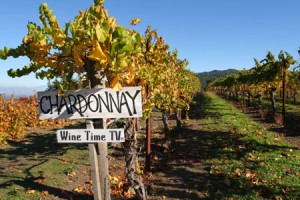 barreled Reserve Tempranillo/Petit Syrah (the barrel is currently tapped to sell some futures on this amazing blend), and that’s when things got interesting. Once again, I personally was blown away by our wine when positioned next to another wine regions “best” wines. The reds we just tried, while fairly good, did nothing to make my taste buds dance the way this humble locally grown number did. So I commented on how sad it is that many local wineries made such crap when this kind of stuff was obviously not only possible, but consistently made by our winemaker, Doug. There are quite a few other craftsmen (wish I could say I knew of a female winemaker out here but I don’t!) making some great elixirs….but there are at least as many helping perpetuate our bad reputation.
So I comment that it’s a shame that many local places were kind of forced to “water down” their wines to stay in business. You see, it has been my understanding that because of the party crews that started coming to Temecula by the busloads (literally) it was not lucrative to manage a vineyard in the way necessary to make some truly drinkable wines. Good wine ALWAYS starts in the vineyard. You cannot make good wine from less than good grapes. But it’s costlier, and requires a knowledgeable and creative hand with a commitment to caring for the entire process. I know this because I have worked in both kinds of wineries, and the wines are dramatically different. Point is, I thought that the bad wines came about as a reaction to the massive numbers of people within an hour’s drive that saw us as nothing more but a place to go for bachelorette parties.
 So, then my fearless leader who knows more about wine, the history of wine, the history of Temecula, and is a virtual walking wine encyclopedia who hails from England and has been everywhere, says the bad wine actually came first. He says that although there were always a few winemakers that were making good stuff, its mostly been in recent years we are seeing a lot more winemakers who know what they are doing and that the proof is in the pudding, or well, the wine. I usually defer everything to Bob, and my first instinct is to take his word as law. He’s my wine mentor, and one of the neatest people you will ever meet. But I am still not convinced…which came first? Was the crappy wine in our beloved valley the beginning of our history or a reflex to the lack of wine buyers that would make producing good wines feasible, if not extremely lucrative?
And then someone said what I guess may be obvious to you….who really cares? For me, it’s an important point to ponder because I want to see “us” succeed as a wine region. I want us to not repeat any part of a history that earned us a sketchy rep. I plan on doing more “research” on the subject, and hopefully will find some answers and some good wines along the way. There is great wine out here…and more to be made. So next up, lets talk varietals…we got ‘em.